
Spreadsheets break. Paper files get lost. WhatsApp approvals disappear the moment someone changes their phone. Plenty of Bangladeshi businesses still run people management this way, and it works right up until the company grows past 30 or 40 employees.
The importance of HR software in business management in Bangladesh comes down to control. Who’s present, who’s been paid, who’s about to resign, and what each of those things costs the business. Without one reliable system, answers take hours instead of seconds.
Most owners don’t notice the damage at first. Payroll errors look small. Leave disputes look like personality issues. Then labour law compliance questions show up, an audit lands, or a good employee leaves because salary came late twice.
This guide explains what HR tools actually do, how the different types differ, and why AI attendance and real-time data matter more than most vendors admit. No jargon, no sales pitch, just what works on the ground in Dhaka and beyond.
What HR Software Does Day to Day
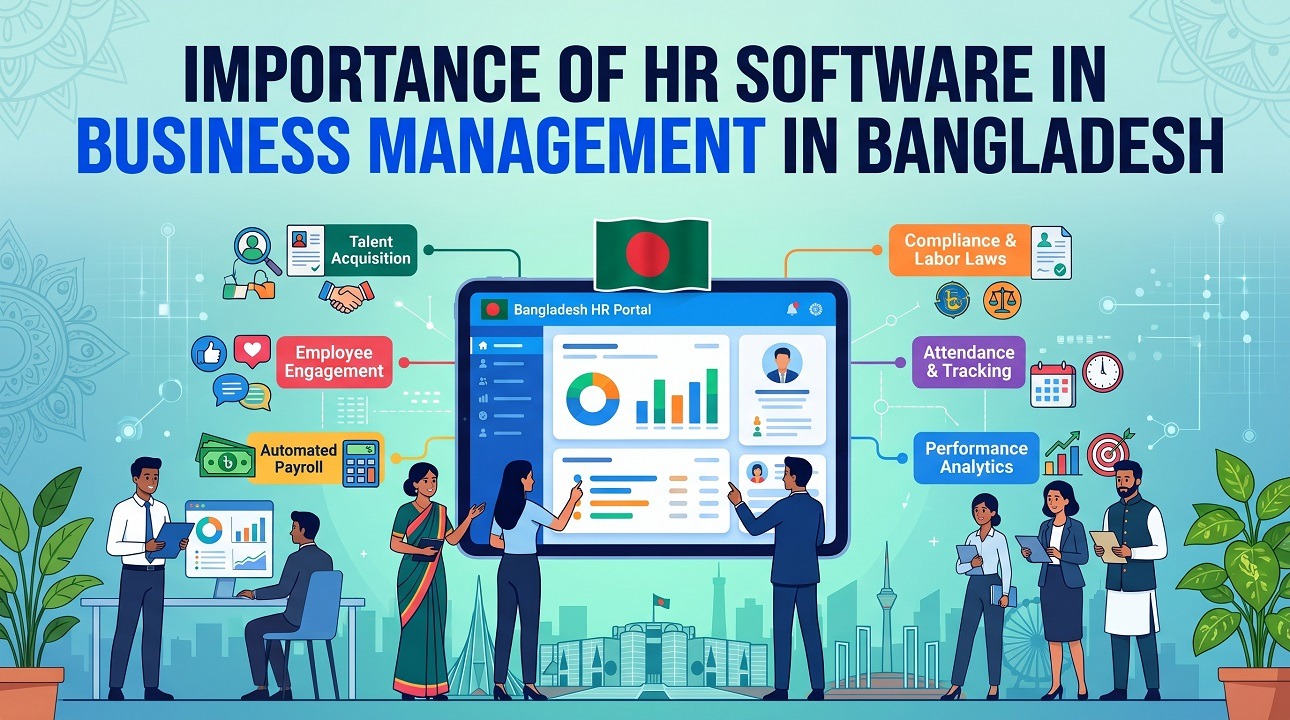
HR software is one system that stores employee data and automates the routine work around it. Recruitment records, contracts, leave, attendance, appraisals, salary, exit formalities. Everything sits in one place instead of five folders and three spreadsheets.
That’s the real reason the importance of HR software in business management in Bangladesh gets underestimated. It doesn’t look exciting. It just removes the daily friction that quietly eats an HR team’s week.
The main functions usually include:
- Employee database and digital files
- Leave and attendance tracking
- Payroll, tax, and benefit calculation
- Recruitment and onboarding workflows
- Performance reviews and goal tracking
- Reports and compliance records
Good systems connect all of these. Poor ones bolt them together and call it a suite.
HR, HRIS, HRM and Payroll: What’s the Difference?
Vendors use these labels loosely. They overlap, but they aren’t identical, and knowing the difference saves money during selection.
HR Software in Bangladesh
HR software is the broad term. It covers anything that helps manage people, from a basic leave tracker to a full platform. HR software in Bangladesh ranges from simple local tools for 20-person offices to enterprise systems built for factories with thousands of workers.
HRIS Software in Bangladesh
An HRIS is the system of record. Think of it as the central database: personal details, job history, documents, emergency contacts, and org structure. HRIS software in Bangladesh matters most for companies that need clean, searchable data for audits, bank requirements, or buyer compliance checks.
HRM Software in Bangladesh
HRM goes further than storage. It manages the processes: hiring, onboarding, appraisals, training, promotions. If an HRIS answers “who works here”, HRM software in Bangladesh answers “how are they doing and what’s next”. Appraisal cycles that once dragged for weeks run on schedule.
Payroll Software in Bangladesh
Payroll is where mistakes get expensive. Good payroll software in Bangladesh calculates basic pay, allowances, overtime, festival bonus, provident fund, and income tax deducted at source. Then it produces payslips and bank-ready salary sheets.
Manual calculation works for ten people. At a hundred, errors become routine.
Most mid-sized companies end up needing all four. Buying them as one connected platform is almost always cheaper than stitching separate tools together.
AI-Based Attendance System: How It Works and Why It Matters
Traditional attendance is a register, a fingerprint machine, or a swipe card. All three can be gamed. Colleagues clock in for each other. Registers get “corrected” later. Fingerprint scanners fail with dusty or sweaty hands.
An AI-based attendance system fixes most of this. An employee steps up to a camera or opens a mobile app. The system captures a face image, converts it into a mathematical template, and compares it with the stored one. A liveness check confirms it’s a real person, not a photo. If it matches, attendance is logged with time and location.
That record flows straight into payroll. No data entry, no month-end reconciliation, no arguments over who was late.
Why it matters comes down to three things:
- Accuracy. Buddy punching practically disappears.
- Flexibility. Field staff and remote workers can check in through geo-fenced mobile apps.
- Speed. Late marks, half-days, and overtime get calculated automatically.
Cost is another point. Most platforms run on a per-employee monthly fee, and hardware needs are modest: a tablet or camera at the entrance, or just smartphones.
Be honest about the limits, though. Poor lighting affects recognition. Internet drops need an offline fallback. Employees should know what’s being stored and why. A system that skips these basics creates new problems.
Real-Time Data Processing and Smarter Decisions
Most companies still look at HR numbers once a month, after payroll closes. By then, the problems are old.
Real-time data processing changes that. Information gets captured and processed the moment something happens: a check-in, a leave request, an overtime approval. Dashboards update instantly. Nobody waits for someone to compile a report.
That’s where the importance of HR software in business management in Bangladesh becomes measurable, because numbers arrive when they can still change an outcome.
The benefits for decision-making are practical:
- Managers see absence spikes the same day, not three weeks later.
- Overtime costs show up while there’s still time to control them.
- Headcount and salary cost reports stay current for budget meetings.
- Rising resignations in one department get noticed early.
Payroll benefits too. Attendance, leave, and overtime reach the salary sheet as they happen, so month-end closing takes hours rather than days.
Faster data doesn’t make decisions smarter automatically. But it removes guesswork, and that’s where most bad HR decisions start.
Why the Importance of HR Software in Business Management in Bangladesh Keeps Rising
Several pressures are pushing companies toward automation. Labour law compliance is one. The Bangladesh Labour Act sets rules on working hours, leave, overtime, and termination, and records need to back up every decision. International buyers in garments and export sectors demand the same documentation.
Bank-based salary disbursement is another. Wages now move through banks and mobile financial services, which means salary files must be accurate and formatted properly.
Then there’s talent. Good people leave over slow reimbursements, late salaries, and unclear appraisals. The importance of HR software in business management in Bangladesh shows up right here: consistent processes keep employees trusting the company.
Growth is the last pressure. A company hiring steadily can’t track leave balances and contracts by hand without errors piling up.
Final Verdict
HR software isn’t a luxury for large corporations anymore. It’s basic infrastructure for any Bangladeshi business with more than a handful of employees. The importance of HR software in business management in Bangladesh is clear in fewer payroll errors, cleaner compliance records, and faster decisions.
Start small if needed. Pick a system that covers HRIS, attendance, and payroll, test it with real data, and train the team properly. Don’t buy for features. Buy for the problems that eat the most time.
The right choice pays for itself within a few payroll cycles. The wrong one just adds another login.